

Plants are able to perceive many different wavelengths of radiation, from UV-B (290nm) to far-red light (780) (Mitani-Sano and Tezuka, 2013; Pettai et al., 2005; Yuling et al., 2007). This perception of radiant light is mediated by photoreceptors. Plants contain several different types of photoreceptors responsible for the detection of different wavelengths of light (Yuling et al., 2007). Cryptochromes are responsible for perceiving wavelengths of UV and blue light (320-500nm), while phytochromes are responsible for perceiving wavelengths of red (600-730) and far-red light (730-780) (Yuling et al., 2007). Many plants rely on cross-talk between phytochromes, cryptochromes, and temperature to induce morphological changes such as flowering (Yuling et al., 2007). This paper will focus on phytochromes and their role in photoperiod dependent responses as well as circadian synchronization of Cannabis sativa.
There are five different phytochromes found in plants (PHYA-PHYE); however, only four of them (PHYA, PHYB, PHYE) are involved in perceiving red and far-red light (Quail et al., 1995; Yuling et al., 2007). Each of these phytochromes are capable of photoconversion upon perception of either red, or far-red light (Quail et al., 1995; Rosenthal, 1998; Yuling et al., 2007). These phytochromes are synthesized in the inactive Pr form, and are converted to the active Pfr form upon perception of red light (Quail et al., 1995; Yuling et al., 2007). This photoconversion of phytochromes from Pr to Pfr is reversible and mediated through either the perception of far-red light or the absence of light (Quail et al., 1995; Rockwell et al., 2006; Rosenthal, 1998; Searle, 1965; Yuling et al., 2007). While the photoconversion of phytochromes upon the perception of red and far-red light happens rapidly, the conversion of Pfr to Pr in the absence of light takes much longer (Rockwell et al., 2006; Rosenthal, 1998; Searle, 1965).
By sensing the alternating far-red, red, far-red spectrums of sunlight, phytochromes are responsible for synchronizing the plant’s circadian clock (Endo et al., 2013; yuling et al., 2007). This circadian clock, combined with phytochromes, are two factors responsible for transcription regulation of a flowering protein CONSTANS (CO), which is involved in regulating expression of a florigen gene, FLOWERING LOCUS T (FT) (Endo et al., 2013). This regulation of flowering genes is largely photoperiod dependent, and reliant on phytochromes to perceive external factors and transcriptionally regulate gene expression internally. In this way, Pr and Pfr are able to regulate flowering in photoperiod dependent plants.
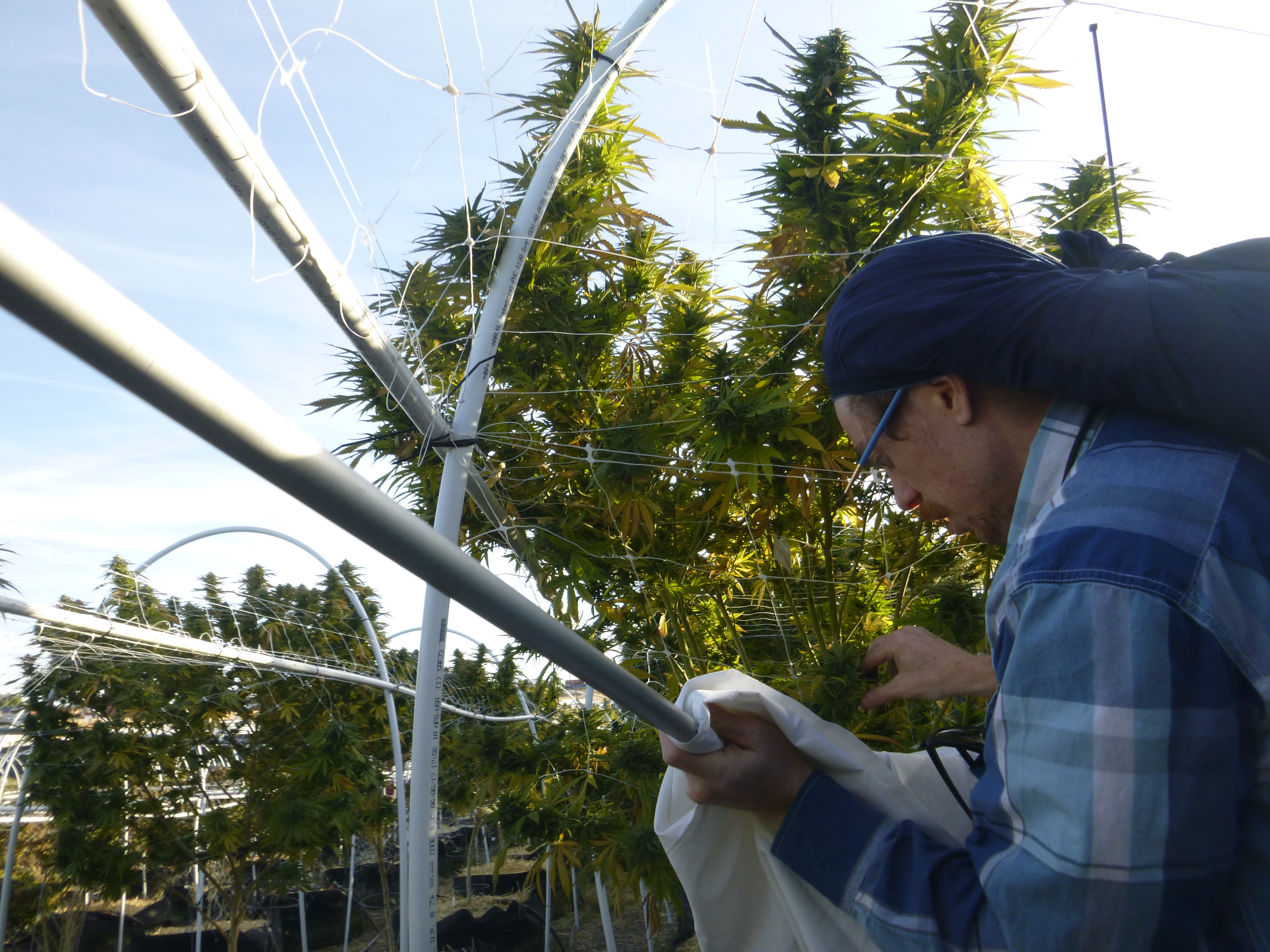
Outside, plants are exposed to far-red light at sunrise and sunset; however, some parts of the canopy do not receive this wavelength of radiation. Cannabis sativa is a short-day plant that relies on long nights to initiate flowering (Rosenthal, 1998). While many plant processes differ between plant species and even within species, the conversion of Pfr to Pr in the absence of light takes about two hours in C. sativa (Rosenthal, 1998). By exposing plants to far-red light immediately after the absence of light in both indoor and outdoor growing environments, C. sativa will photoconvert all remaining Pfr to Pr. By not having to wait two hours for Pfr to convert to Pr, the plant will be able to produce more FT, resulting in a quicker flowering response in the absence of light. In this way, the introduction of far-red light can effectively reduce the length of the dark cycle needed to induce flowering in C. sativa by two hours. A shorter night period allows for a longer light period and increased photosynthesis.
Works Cited
Endo M., Y. Tanigawa, T. Murakami, T. Araki, and A. Nagatani. 2013. Phytochrome-dependent
late-flowering accelerates flowering through physical interactions with phytochrome B
and CONSTANS. 110(44):18017-18022.
Quail, P.H., M.T. Boylan, B.M. Parks, T.W. Short, Y. Xu, and D. Wagner. 1995. Phytochromes:
Photosensory perception and signal transduction. Science. 268(5211):675-680.
Mitani-Sano, M., T. Tezuka. 2013. Near-UV radiation acts as a beneficial factor for physiological
responses in cucumber plants. Journal of Phytochemistry & Photobiology. 128:64-69.
Pettai, H., V. Oja, A. Freiberg, A. Laisk. 2005. Photosynthetic activity of far-red light in green plants. BBA-Bioenergetics. 1708(3):311-321.
Rockwell, N.C., Y. Su, J.C. Lagarias. 2006. Phytochrome structure and signaling mechanisms. Annu. Rev. Plant Biol. 57:837-858.
Rosenthal, E. 1998. Marijuana grower’s handbook. Quick American Publishing. Oakland, CA.
Searle, N.E. 1965. Physiology of flowering. Annu. Rev. Plant Biol. 16:97-118.
Yuling, J., O.S. Lau, and X.W. Deng. 2007. Light-regulated transcriptional networks in higher plants. Nature Reviews Genetics. 8(3):217-230.